
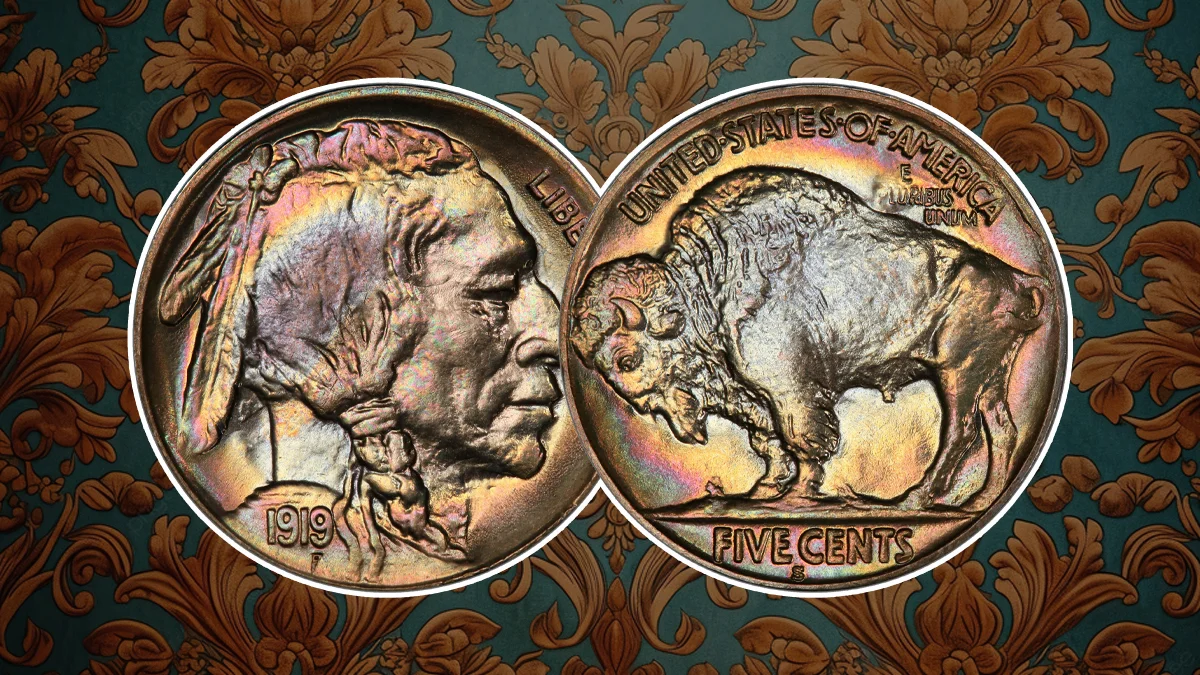
The 1919-S Buffalo Nickel is a favorite among coin collectors for its rich history and iconic design. While the San Francisco Mint produced more than 7.5 million of these nickels, finding one in excellent condition isn’t as easy as the mintage numbers might suggest. Many coins entered circulation soon after they were released, and the dies used to strike them were often worn, leaving weak details on the finished coins. Because of this, high-grade examples with sharp features are much harder to find and are highly valued by collectors today.
History of 1919 S Buffalo Nickel
Designed by celebrated American sculptor James Earle Fraser, the Buffalo Nickel—also known as the Indian Head Nickel—was introduced in 1913 and remained in circulation until 1938. The coin beautifully captures the spirit of the American West, featuring a Native American portrait on the obverse and an American bison on the reverse.
The 1919-S Buffalo Nickel was struck at the San Francisco Mint, with a total mintage of 7,521,000 coins. Although this production figure was relatively high, many surviving examples show soft or incomplete details because they were struck using worn dies. Years of everyday use also caused heavy wear on most coins, making well-preserved specimens much scarcer than the original mintage suggests. Today, collectors especially seek out examples with strong strikes, attractive surfaces, and minimal wear, as these qualities significantly increase both their appeal and value.
Specifications
- Year: 1919
- Mint Mark: S (San Francisco)
- Type: Buffalo Nickel
- Face Value: 0.05 USD
- Mintage: 7,521,000
- Edge: Smooth
- Composition: 75% copper, 25% nickel
- Weight: 5 grams
- Diameter: 21.2 mm
Design
Obverse
The 1919-S Buffalo Nickel’s obverse shows a Native American profile that is considered to be made up of Iron Tail, Two Moons, and Big Tree, three distinct chiefs. The word “LIBERTY” has been placed along the right side, while the date “1919” appears to the left. Below the date is the designer’s initial “F” (for Fraser).
Reverse
On the reverse is an image of an American bison, which is also known as a buffalo. “E PLURIBUS UNUM” and “UNITED STATES OF AMERICA” appear above the buffalo, and “FIVE CENTS” is written at the bottom. This is the mint mark “S” below the phrase “FIVE CENTS.”
Rarity and Condition
The 1919-S Buffalo Nickel is considered rare in its current state. Though there are many examples, very few are actually of gem quality. Weak strikes may lead even Mint State coins to have soft edges and less-than-ideal surfaces. The best samples that are now available have been classified as MS66+ by NGC and MS66 by PCGS; one MS66 specimen sold for a record $109,250 at auction.
Value of 1919 S Buffalo Nickel
The value of a 1919-S Buffalo Nickel varies significantly based on its condition. Here is a general price guide:
Circulated Grades
- Very Fine (VF): $125
- Extremely Fine (EF): $300
- About Uncirculated (AU): $525
Uncirculated Grades
- Mint State 61 (MS61): $900
- Mint State 63 (MS63): $1,750
- Mint State 65 (MS65): $10,000
- Auction Record (MS66): $109,250
In average circulated (AC) condition, the coin is worth around $10.00. In certified mint state (MS+) condition, it can fetch as much as $1,155 at auction.
Errors
Like many coins of its era, the 1919-S Buffalo Nickel can exhibit a variety of minting errors. These can include die cracks, repunched mint marks, and off-center strikes. Such errors can significantly increase the value of the coin, depending on their severity and rarity.
Also Read – 1917 S Buffalo Nickel: A Comprehensive Guide for Coin Enthusiasts
Conclusion
An interesting coin of American numismatic history is the 1919 S Buffalo Nickel. It has to be a desirable coin for collectors, especially those interested in high-grade examples, despite its relatively poor appearance in lower grades. Whether you are a beginner or an experienced collector, understanding the subtleties of this coin can help you understand both its historical and financial value.